Corleone Lodge
The Man Who LaughsCorleone Lodge is a palace at Windsor whose grandeur and concealed passages give physical form to the novel’s uneasy conjunction of aristocratic privilege, private access, and disorientation. A favored residence of Josiana and a property within the Clancharlie inheritance, it is both a courtly address close to the queen and the setting of Gwynplaine’s bewildering attempt to escape toward Dea.
Setting and Architecture
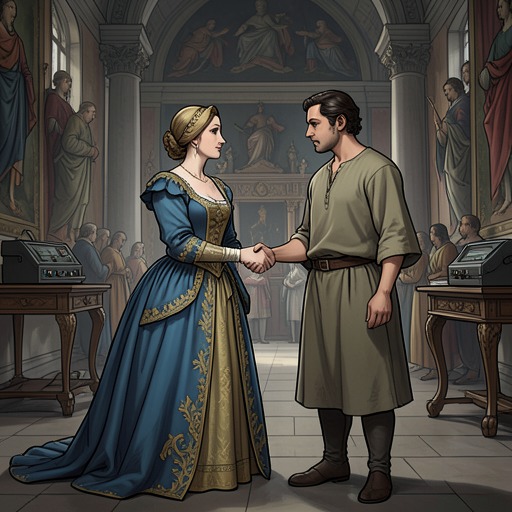
Corleone Lodge is described as a Florentine palace of brick and stone, raised on pilework and fronted by a marble colonnade. It stands at the head of the wooden bridge at Windsor, near Windsor Castle, and possesses one of the finest courts in England. Its impressive exterior belongs to a world of rank and display: the building is not merely a private home but part of the architectural landscape of royal power.
The palace’s court is organized around three iron-railed gates. The broad central entrance admits carriages; a smaller gate on the right is for riders, and the narrowest, on the left, for pedestrians. Their glittering points and the sculpture above the central gate frame an approach designed to distinguish kinds of entry. Beyond them, pale columns and paving give the courtyard a snowlike appearance. A mosaic set into the flags would, in daylight, reveal a many-coloured and elaborate coat of arms in the Florentine fashion. Terraced stairs rise and fall behind balustrades, while the large roof, vaulted gables, visor-like attic windows, tower-shaped chimneys, and entablatures bearing motionless gods and goddesses complete the palace’s imposing silhouette.
Residence and Courtly Access
Josiana is particularly fond of Corleone Lodge, despite its proximity to the queen. At Windsor she remains within the queen’s reach, a closeness that makes the residence part of court life as much as a place of private retreat. The lodge is paired with Hunkerville House in London: both are Josiana’s favored residences, and both belong to the Clancharlie inheritance.
The connection between these houses is also made literal by a master-key entrusted to Barkilphedro. It has two sets of wards, one at either end, and opens the inner apartments of both residences. Josiana had given confidential keys to two men: Lord David had one, and Barkilphedro the other. The arrangement reflects a courtly culture in which a key to someone’s rooms could signify unusually intimate confidence, while entry into a bedchamber was not necessarily considered improper by the old code of manners. At Corleone Lodge, therefore, private space is not sealed off from the networks of observation and access surrounding its inhabitants.
Josiana’s Summons to Windsor
After the confrontation between Hardquanonne and Gwynplaine, a royal post-chaise was sent from the queen to fetch Josiana from London to Windsor. Josiana would have preferred to disobey, or at least postpone her departure, but court life gave her little room to refuse. She had to leave Hunkerville House at once and go to Corleone Lodge.
The move did not bring an immediate audience. On reaching Windsor, Josiana learned from the Usher of the Black Rod that the queen was meeting with the Lord Chancellor and would not receive her until the following day. She was ordered to remain at the lodge and await the queen’s commands after the queen awoke. The imposed delay shapes her arrival: she enters the house spiteful, eats supper in a bad humour, dismisses everyone, including her page, and goes to bed while it is still daylight. She has also learned that Lord David Dirry-Moir is expected at Windsor the next day, having been ordered back from sea to receive the queen’s commands. The lodge thus becomes a place where royal authority governs both movement and waiting.
Gwynplaine in the Palace
Corleone Lodge later receives Gwynplaine under radically altered circumstances. After the shock of his change in fortune, he comes to himself at night in a large chamber lined with purple velvet across its walls, ceiling, and floor. A fat man in a travelling cloak stands nearby, his head uncovered. Two tables are within Gwynplaine’s reach: one holds two branches of six lit wax candles apiece, along with papers and a casket; the other bears refreshments, including a cold fowl, wine, and brandy on a silver-gilt salver.
Through a floor-to-ceiling window, Gwynplaine can see the courtyard in the clear April night: its three gates, columns, pale paving, shadowed mosaic, terraces, and enormous palace roof. The ordered magnificence visible from the chamber contrasts with the disorientation of the man inside it. The narrative presents the lodge not only as a rich setting but as a space in which Gwynplaine’s changed circumstances become materially immediate.
In the palace’s little rooms, that disorientation turns into a physical obstacle. Gwynplaine is desperate to get outside and see Dea again, but narrow, winding passages, alcoves, and secret doors make a simple departure impossible. He expects a single door and instead encounters a succession of rooms and crossings. He tries to hurry but is forced to wander; no living person appears, and he hears no sound. At moments he thinks he is returning toward his starting point or sees someone coming, only to discover that the figure is his own reflection in a mirror, dressed as a nobleman. He recognizes himself, but not at once. The lodge’s maze makes his new appearance and status strange to him even as it delays his return to the person he longs to see.